Master of Engineering in Design Intelligence
The rapid integration of AI, advanced technology, and human-centered design has created a soaring market demand for interdisciplinary leaders who can bridge the gap between engineering capabilities and human needs—a role traditional, siloed education programs fail to fill.
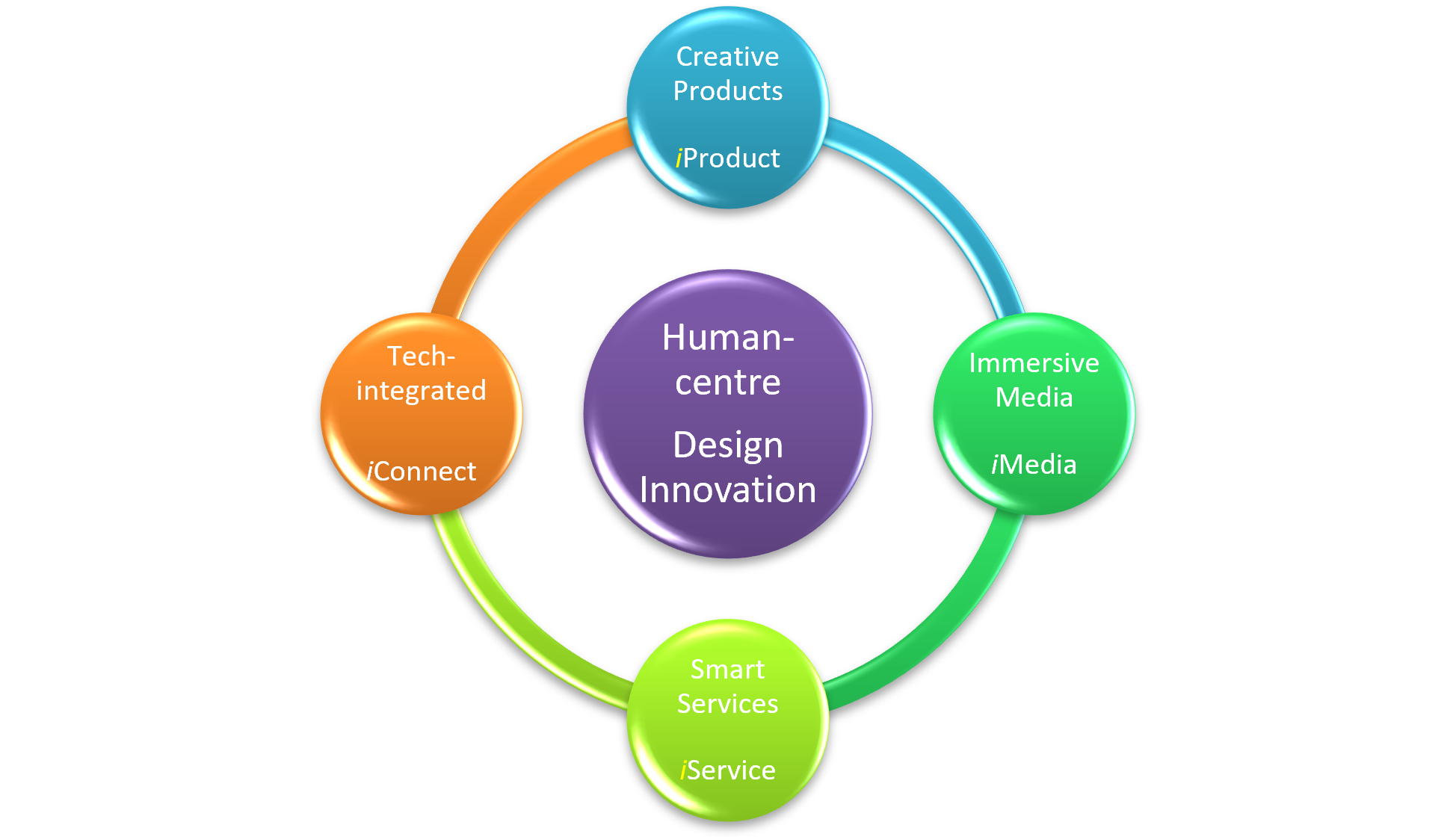
To address this gap, the Master of Engineering in Design Intelligence is proposed to cultivate "Design Strategists" and "Creative Technology Connectors." Recognizing that creativity adds substantial intangible value and competitiveness to products and services, the program emphasizes innovation in both product and service/process design. Its curriculum features four integrated course clusters—iProduct, iService, iConnect, and iMedia—each blending core and bridging elective courses. A broad selection of electives is also provided to help students customize their learning and broaden their knowledge.
This program directly aligns with the Hong Kong SAR government's strategic focus on the new creative economy. By leveraging Hong Kong's unique "east-meets-west" cultural positioning and traditional economic strengths, the initiative aims to produce tech-fluent creative talents. These innovators will integrate AI into their pipelines to design next-generation user experiences across the region's core sectors, including retail, finance, and professional services.
Educational Objectives
Master of Engineering in Design Intelligence (DI) program aims to impart students with a comprehensive and holistic understanding of emerging technologies, innovative design strategies, and new business models. Additionally, it seeks to equip students with advanced digital skills essential for product development, transmedia communication, and business growth, addressing the increasing demand for skilled professionals in these areas. Furthermore, the program is designed to attract high-caliber candidates to join the industry, fostering a talented and innovative workforce for the future.
Learning Outcomes
Upon completion of the program, graduates will be able to:
- Develop and enhance individual creativity and design skills within product, service, and process contexts, supported by relevant research methodologies to address industry challenges.
- Gain a global perspective on design strategies and business issues, continuously updating knowledge of current and emerging technologies within an integrated design framework.
- Communicate effectively and professionally across verbal, digital, and visual formats to support managerial decision-making in marketing and management.
Program Characteristics
| Deep Integration of Design & Technology | The program is fundamentally design-led, with technology—especially AI—woven throughout as a central thread. It moves beyond tool-use to strategic application. It emphasizes on the understanding of the societal implications, limitations, and ethical responsibilities of designing with AI and future technologies. |
| AI-Empowered Creativity & Strategy | A dedicated focus on using emerging technologies, including Generative AI, as creative partners for brainstorming, concept generation, iteration, and data-driven design decision-making. |
| Integrated One-Year Internship | A key differentiator, the program includes a dedicated year of industry placement (ISDN6740) for full-time students. This allows students to gain real-world experience, build professional networks, and enhance their employability, creating a seamless transition from academia to industry. |
| Project-Based Learning (PBL) | The key approach for program delivery is PBL, and the program is integrated with several industry collaboration projects (ISDN5701 and ISDN5702) as well as a capstone project (ISDN6730) that requires students to apply the learned skills to solve real business problems, and deliver design solutions in a practical, portfolio-ready manner. |
Curriculum
Students are required to complete a total of 36 credits. This includes 12 credits from core courses, 12 credits from elective courses-which include 6 - 9 credits in bridging elective courses and 3 - 6 credits in other elective courses in any of the 4i areas-and 12 credits from a required Capstone Project (6 credits) and a year-long Internship Placement (6 credits).
For details, please refer to the Postgraduate Program, Course Catalog.
36 Credits
iProduct: Product Ideation and Development (ISDN5701)
iService: Design for Transformation (ISDN5702)
iConnect: Emerging Technologies for Design Innovation (ISDN5703)
iMedia: Transmedia Design and Production (ISDN5704)
Each capstone project will be supervised by at least one faculty member. Students are encouraged to associate their internship training with their capstone projects, and in such cases, the capstone project will be supervised or co-supervised by at least one faculty member and one industry expert.
Admission & Application
Applicants should have obtained a bachelor's degree in design, technological areas, business, or related disciplines (e.g., communication, multimedia, psychology or ergonomics), from a recognized institution, or an approved equivalent qualification.
For other general admission requirements of the University as well as then English Proficiency Requirements, please refer to HKUST Fok Ying Tung Graduate School.
Program Fee
| Normative Program Duration | 2 Years |
| Mode of Study | Full-time |
| Program Fee | HK$400,000 for 2027/28 Fall intake (paid in 2 installments) |
Faculty Members
This program is a gateway for students to learn from our professors with diverse knowledge and research experience in the field gained from some of the top engineering institutions from around the world.
Additional Information
- Applicants with a bachelor’s degree in any of the following disciplines are preferred, including Product or Industrial Design, Fashion and Textiles, Multimedia Communication, Marketing, Artificial Intelligence, Data Analytics, Machine Learning, Software Engineering, or Industrial Engineering
- Applicants with working experience are at an added advantage but it is not compulsory.
- Applicants should submit a personal statement of approximately 500 words in English.
- Applicants should submit a curriculum vitae (CV), proof of qualifications, academic transcripts, and awards, if any.
- Applicants may submit a portfolio (e.g., collection of recent design work, demonstrations, publications, personal website, or Github repositories) in support of their applications.
- Merit-based Entrance Scholarships^ are available for high-calibre candidates who demonstrate outstanding academic achievement and strong potential for success in the program.
- Local applicants may also consider applying for the Hong Kong Future Talents Scholarship Scheme for Advanced Studies. For more information, please visit the UGC website.
^ All eligible applicants will automatically be considered for the scholarships based on their application materials. No separate scholarship application is required. Successful candidates will be notified of any scholarship award by the MEng DI Program Office.
Application Deadlines
For 2027/28 Fall Term Intake (commencing in Sep 2027):
| Round 1 | 1 December 2026 |
| Round 2 | 15 February 2027 |
| Round 3 | 30 April 2027 |
All applicants are considered on a competitive and rolling basis. Early online application is strongly recommended.
Apply now before the above application deadlines.
Contact Us
| enquirydi@ust.hk | |
| Tel | +852 3469 2957 |
| Address | Room 5313, 5/F, Lift 3, The Hong Kong University of Science and Technology, Clear Water Bay, Hong Kong |
| Social Media |     |